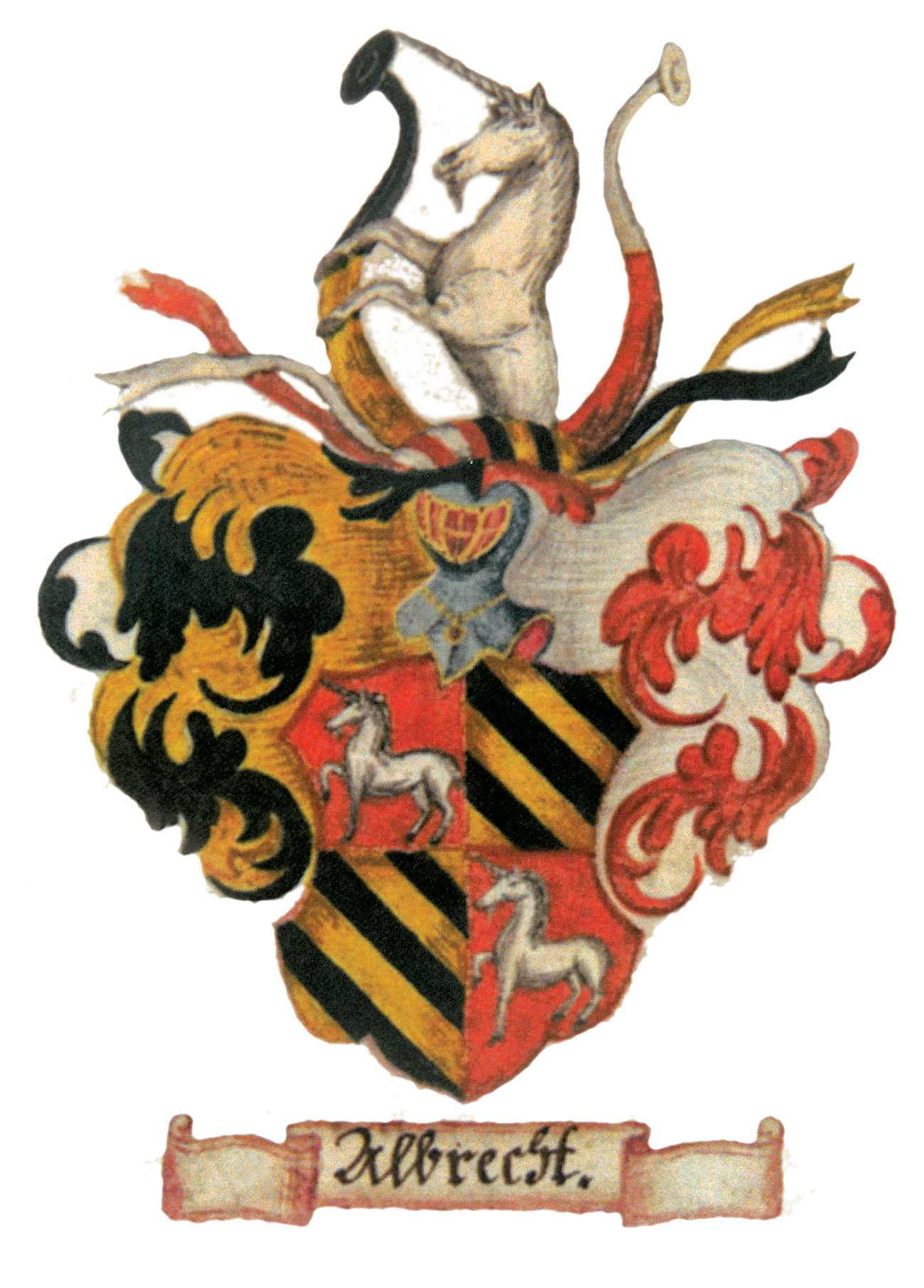
The Albrecht family of Rothenburg ob der Tauber
Family Motto

Albrecht family ‘motto’ as it appears on the Albrecht-Husel tomb in Rothenburg ob der Tauber

NIL HUMANA MOROR DUM SUPRA AERA VOLO
I care nothing for human affairs while I fly above the stars
Nil humana moror, dum supra aera volo – The ‘Motto’ of the Albrechts of Rothenburg
( It should be noted that research into the family motto of the Albrechts of Rothenburg remains an ongoing project)
- What is the origin of the Latin motto, and what does it represent?
This first question is, on the surface, easy enough to answer. The Latin words are too close to an epitaph of the Holy Roman Emperor Maximilian II (died 1576) to have come from any other source. The actual words, and their sequence, is an issue which we’ll come to in a moment, but, in the case of Maximilian II, they refer to the attendant symbolism of an eagle (sometimes – probably erroneously – described as a dove) flying through the clouds above an assortment of imperial insignia on the ground that, depending on which account you read, includes one or more royal crowns, a sword, an orb, a sceptre, a lance, and a globe of the world. The Latin epitaph, referring to the emperor as symbolised by the eagle, translates literally as I care nothing for earthly things while I am borne (or, in some versions, fly) above the stars (or, in some versions, airs or heavens).
The symbolism is pretty well attested to originate in the Gospel of Saint John (which is considered the most ‘mystical’ of the gospels) and its associated apocrypha, and revolves around the Passion and Ascension of Christ. The eagle represents the soul of the saint[1] (or, in some interpretations, of Jesus, himself) which, although its body is still earthbound, seeks to follow its beloved Master (Jesus) to an abode in heaven and is, hence, immune to the allure of earthly materialism and its attendant ephemeral pleasures. This type of religious nature-allegory is totally in keeping with the artistic movements in vogue during and after the rule of Maximilian II (reigned 1564-1576),[2] and represents the soul of the Emperor leaving behind the earthly trappings of a reign well managed, and ascending to his eternal and even more glorious abode in heaven.
Despite the literal translation of the Latin, differing German language interpretations of it (translated below into English) can be found amongst the various extant references to the epitaph, such as:
Nil humana moror, dum ad astra feror – lit. I care nothing for earthly things, while I am borne towards the stars – German: I care nothing for the thunder of the world / and I soar up to heaven[3]
Nil humana moror, dum super astra feror – lit. I care nothing for earthly things, while I am borne above the stars – German: Nothing on earth troubles me / when I have the ability to soar into the sky[4]
Nil humana moror, dum super astra feror – lit. I care nothing for earthly things, while I am borne above the stars – German: I ask for nothing on the earth any longer / As my God will become my payment[5]
Nil humana moror, dum super astra feror – lit. I care nothing for earthly things, while I am borne above the stars – German: Four crowns I have left behind, the fifth is there (i.e. in heaven) to get (this rather fanciful rendition does not really attempt to translate the Latin verse as it appears as part of a much longer passage that was set to music, the whole of which describes a monument).[6]
Nil humana moror, dum super astra volo – lit: I care nothing for earthly things, while I fly above the stars – German: What do I care for monarchy and honours / Up there in heaven I shall find more[7]
All the sources listed above refer to the same epitaph, although the slight variations between several of them would indicate few, if any, of the copyists had actually seen the original first hand, and most of the German ‘translations’, are attempts to mirror in German verse, the Latin rhyme of the original. The original Latin lines with attendant imagery are supposedly engraved near the tomb (one source says on a funerary token, another even mentions a coin) of Maximilian II which lies in the cathedral of St. Vitus, Prague, in modern day Czechia. As yet, we have been unable to source an image of the original engraving.
- Why did the Albrechts choose that particular motto?
The issues surrounding this question are a lot more problematic. In the absence – thus far – of any verifiable documentation relating to the Albrecht family’s adoption of the motto, any suggestions made here must, of necessity, remain purely speculative.
The first appearance of the motto on an Albrecht monument is an engraving on the Albrecht – Husel tomb in Rothenburg ob der Tauber. Georg Albrecht (1603-1666) and Susanna Husel (d. 1682) are interred there, so the earliest attested link between the Albrecht family and the motto, seems to be around the latter half of the 17th century.
The Holy Roman Emperor Maximilian II was, for the troubled times in which he lived, a religiously enlightened ruler, in that his policies were geared to avoid any inflammation of the uneasy religious tension that existed between the Catholic and Protestant factions within his empire. He was also keenly interested in science and the arts. With the external threat from the Ottoman Turks still very real, Maximilian’s reign (1564-1576) was, by-and-large, a peaceful one within the borders of the Holy Roman Empire itself.
Our first speculation, then, for the adoption of Maximilian’s epitaph as a family motto, is that the Protestant Albrechts of Rothenburg, patrician members of a Lutheran city council that had, by the mid-1600s, long learned to get along with Catholic rulers, saw it as prudent to adopt the epitaph of a safely deceased Holy Roman Emperor who was known for his tolerance towards Protestantism. This consideration can be said to be further strengthened by the popularly held notion, still prevalent in the 17th century, that Maximilian II had actually died a Protestant (at least ‘in his heart’). After all, the Emperor had been tutored when young by a Protestant from Schweidnitz (modern day Swidnica, Poland, an important town in the province of Silesia), and rumours of religious differences between Maximilian II and his father, Ferdinand I, were still doing the rounds well after both their deaths.
Another possibility for the Albrecht family adopting Maximilian’s epitaph for their motto is also connected to Schweidnitz. The Friedenskirche or Peace Church in Schweidnitz is named for the Peace of Westphalia in 1648 which effectively ended Europe’s calamitous religious conflict known as the Thirty Years War. In that church is a Castrum Doloris on which are engraved the words Nil humana moror, dum super astra feror, again referring to the epitaph of Maximilian II. The Friedenskirche in Schweidnitz was a concession to Protestant worship in an otherwise strongly Catholic area. Could the Albrechts of Rothenburg ob der Tauber (a similarly protestant enclave in an otherwise Catholic dominated area) have known of the monument at Schweidnitz and, because of its connection to an Emperor known to have had Protestant inclinations, have seen it as a fitting motto to adopt, especially with the new ‘peace’ settling over the war-ravaged Empire?
Perhaps the strongest link we can bring into our speculation is a prosopographical one, and it is again, closely linked to the region of Silesia and its tradition of strong, Protestant enclaves in an otherwise Catholic dominated region. The closest documented source to the exact wording on the Albrecht – Husel tomb in Rothenburg ob der Tauber, can be found in what appears to be (the digitalisation leaves a lot to be desired) some kind of funerary or memorial church service for the early death of Sylvius III, who died either during or shortly after childbirth, and who was the third son of Sylvius Nimrod I (1622-1664), the first Duke of Württemberg-Oels (the duchy of Oels part of which title he inherited when he married Elizabeth Marie, duchess of that territory in Silesia). The document looks to have been published in Wittenberg in 1661.[8]
Albrecht-Husel Tomb: Nil humana moror, dum supra aera (or, possibly, astra) volo
Ortlob Document: Nil humana moror, dum super astra volo
The Ortlob document is the only source other than the tomb engraving, in which the second verb is given as volo (I fly) rather than feror (I am borne/carried). This is intriguing in itself as the verb combination in all other sources moror/feror rhymes (something one would expect from this type of ‘couplet’) whereas the Albrecht – Husel tomb engraving and the Ortlob document do not; something that, in our opinion, strengthens the link between the two.
The important thing to realise about this dynasty of the Dukes of Württemberg-Oels is that they were very prominent and staunch Protestants (Calvanist). Georg Albrecht (1603-1666) is known to have had many dealings with prominent Lutherans, especially in and around his alma mater Strasbourg. It is possible, then, that he, or one of his immediate successors may have had some dealings with either the Dukes of Württemberg-Oels, or, more likely, with Carl Ortlob himself, who had attended the University at Wittenberg around 1647, returned to Oels, and died in Breslau (modern day Wroclaw, Poland), where he served as Deacon in the Elisabethkirche (a protestant bastion right up until 1945) until his death in 1678. Ortlob wrote and published on religious poetry and church music and hymns.
Conclusion
At this stage, it is impossible to pinpoint exactly when and by whom Maximilian II’s epitaph (or a slight variation on it) was adopted by the Albrechts of Rothenburg ob der Tauber as their family motto. The evidence, circumstantial as it is, points to the latter half of the 17th century and either Georg Albrecht (1603-1666) or one of his immediate successors but more research is required.
References
[1] The eagle came to represent the Evangelists in general but Saint John in particular, especially in iconography of the middle ages and early modern times.
[2] See Altfahrt Margit (1981) Die Politische Propaganda für Maximilian II (zweiter Teil). The version of the epitaph in this publication Dum super astra feror, nil humana moror can be found on p.90.
[3] Kruger, Martin (1711) Evangelischer Tugend Orden p.49
[4] Possibly a memorial service for Engelbert (1748) Lob und Ehren Predig p.11
[5] Reiffenstuel, P. Ignatio (1711). Reichs-Herschende Bild Säule
[6] Aderhold, Stephan (2015) Chronologische Musikgeschichte der evangelischen Gemeinde in der Friedenskirche zu Schweidnitz unter Berücksichtigung der Entwicklung ihres Kirchenarchivs
[7] Ortlob, Carl (1661) Würtembergisch – Oelβnische Himmelfahrt
[8] Ortlob, Carl (1661) Würtembergisch – Oelβnische Himmelfahr. Carl Ortloben